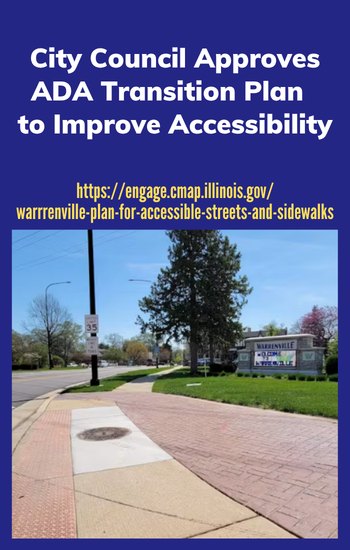
Warrenville's City Council adopted an Americans with Disabilities Act (ADA) transition plan covering sidewalks, curb ramps and street crossings. The plan estimates $5.67 million to fix accessibility barriers across the city.
The city announced the approval in an Oct. 20 civic alert. City staff and officials spent about a year developing the plan, according to the announcement.
A separate page on the Chicago Metropolitan Agency for Planning (CMAP) engagement site states the council adopted the plan on April 6. The city's alert did not specify a vote date.
Warrenville developed the plan with technical assistance from CMAP and the consulting firm Kimley-Horn. The effort included a community survey, an online mapping tool, a steering committee, seven interviews and three public engagement events, according to CMAP.
A technical assessment evaluated roughly 60 miles of sidewalk corridors and 374 unsignalized intersections and driveways. Of those, about 2.2 miles of sidewalk and 203 intersections or driveways received a high-priority rating. Each location was scored on the severity of the barrier, proximity to schools, parks and businesses, and demographic factors.
The total cost to address every identified barrier is approximately $5.67 million, according to the city. CMAP's account puts the figure at roughly $5.7 million, with about $2.4 million projected for high-priority fixes. The city said improvements will be folded into ongoing projects and coordinated with road work, trip-hazard removal, private development and grant opportunities.
Residents who participated in the process flagged concerns around Batavia Road and Virginia Avenue, according to CMAP. Other issues included street lighting, busy crossings, maintenance gaps between jurisdictions and pedestrian access during community events.
The city has already repaired more than 11 miles of sidewalk through its annual repair program. That work is separate from the new plan.
Warrenville said it will update the plan regularly and evaluate progress each year. The $2.4 million in high-priority fixes along routes near schools, parks and businesses will be the first targets as the city builds accessibility work into upcoming budgets.